
The right choice between a kitchen island and a breakfast bar can transform how your family lives, entertains, and moves through your home — and it deserves the same level of care as every other decision in a serious remodel.
There is a question we hear on nearly every kitchen remodel consultation we walk into across St. Louis, whether it is a classic brick two-story in Webster Groves or a newer construction in Chesterfield: should we do a kitchen island or a breakfast bar? The answer is never one-size-fits-all. It depends on how you cook, how you gather, how much floor space you have to work with, and — perhaps most importantly — how you want your kitchen to feel when you walk into it at six in the morning or when you have twelve people over for a dinner party.
At Morganco Design Build, we have spent three generations helping St. Louis homeowners make exactly these kinds of decisions — not as salespeople, but as craftsmen who will be building the thing, living in the details, and standing behind it long after we leave the job site. This guide is our honest breakdown of both options: what they do well, where they fall short, and how to know which one belongs in your kitchen.
Kitchen Island vs. Breakfast Bar: The Core Difference Explained
A kitchen island is a freestanding or fixed structure positioned in the center of the kitchen floor plan. It is fully accessible from all four sides, which makes it the most versatile piece of real estate in any kitchen. Islands can house cabinetry, a prep sink, a cooktop, wine storage, appliance garages, and seating — sometimes all at once. They function as a work surface, a gathering hub, and a storage solution simultaneously.
A breakfast bar, on the other hand, is a counter-height or bar-height seating surface that is attached to — or an extension of — an existing counter, peninsula, or wall. It is defined by its relationship to a fixed structure. Breakfast bars are typically accessed from one or two sides and are designed primarily for casual dining and conversation rather than meal preparation.
The distinction matters because these two features solve different problems. An island expands your functional workspace and storage. A breakfast bar maximizes seating in a compact footprint. Both can anchor a beautifully designed kitchen — but only when matched to the right layout, lifestyle, and square footage.
The most common mistake we see is homeowners choosing based on what looks impressive in a magazine rather than what will actually serve the way they live. A stunning ten-foot island in a kitchen that cannot comfortably accommodate it becomes the most expensive obstacle in the room.
— Morganco Design Build, St. Louis
The Kitchen Island: Workhouse, Gathering Space, and Design Centerpiece
When the floor plan supports it, a well-built kitchen island is arguably the single greatest investment a homeowner can make in their kitchen. It adds prep space, storage, and seating in one cohesive structure — and when designed with intention, it becomes the centerpiece around which the entire room is organized.
What Makes a Kitchen Island Worth Building
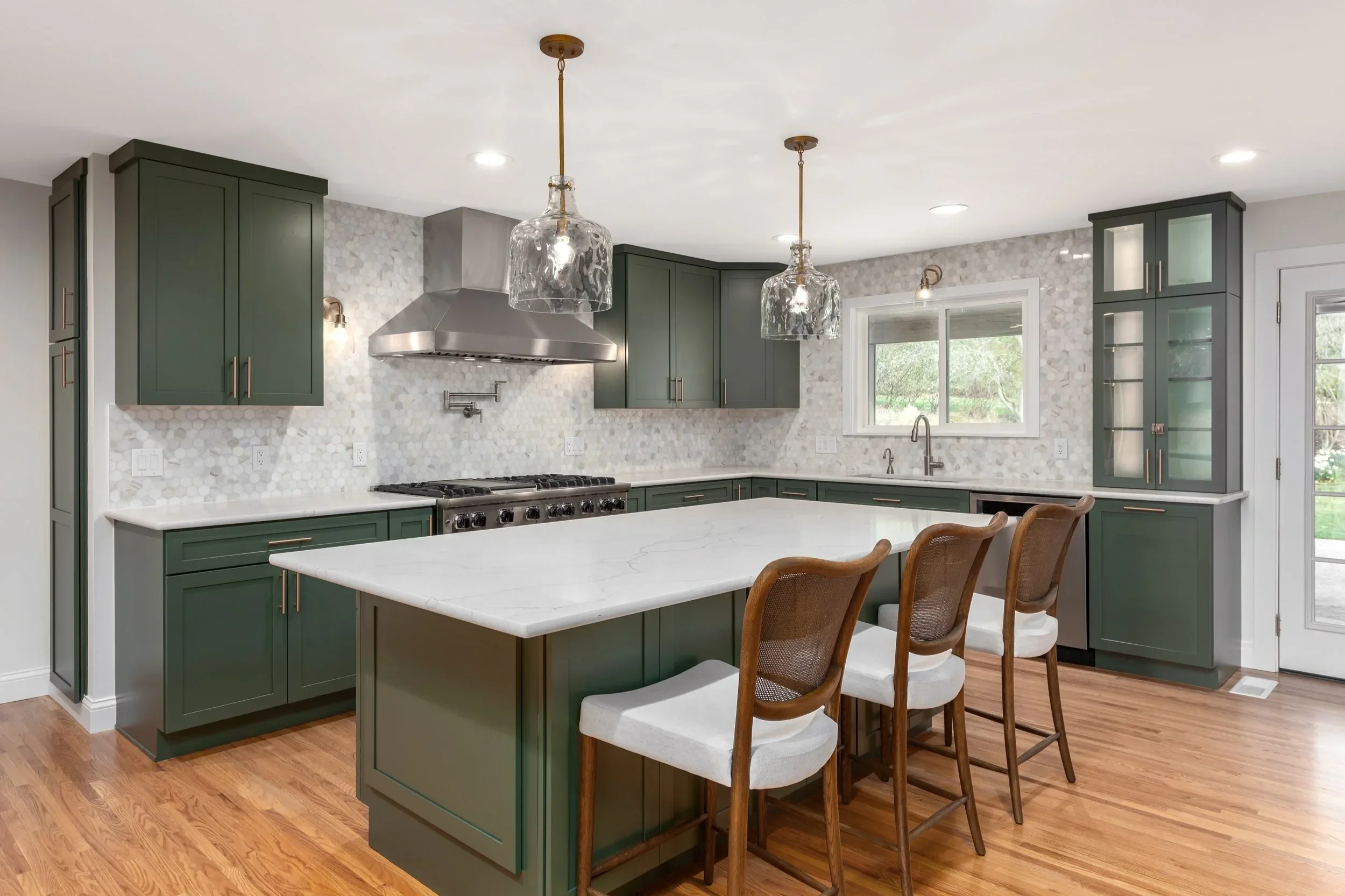
An island earns its footprint when it is designed to do real work. The kitchen pictured above — a project we completed for a family in the Dominion area — demonstrates this balance precisely. The island there spans a generous working surface finished in white Calacatta marble, providing ample room for rolling dough, staging a charcuterie spread, or setting down groceries without disrupting the primary cooking zone. The base is clad in the same deep forest-green shaker cabinetry as the perimeter, giving the kitchen a sense of cohesion rather than contrast.
What you cannot see in that photograph is the drawer storage concealed within the island base — soft-close, full-extension, dovetail-joined boxes built to handle daily use for decades. That level of construction is not visible once the drawer closes, but the homeowner feels it every single day. That is the difference between cabinetry that is built and cabinetry that is crafted.
Ideal Conditions for a Kitchen Island
Minimum 42 inches of clear walkway on all working sides — we prefer 48 inches when budget and space permit
Kitchen footprint of at least 10 by 12 feet, with larger islands requiring proportionally more floor space
Households that cook seriously — multiple cooks, meal prepping, or frequent entertaining benefit most
Homeowners wanting integrated appliances such as a prep sink, undercounter refrigerator, or cooktop in the island
Layouts where the island can visually anchor an open-concept living and dining area
Families with children who need a dedicated homework or snack station separate from the primary cooking zone
Island Seating: The Overhang That Changes Everything
One detail that separates a thoughtfully designed island from a merely functional one is the seating overhang. Standard counter height of 36 inches pairs with a 12-to-15-inch overhang for standard counter stools. Bar height at 42 inches calls for a deeper overhang and taller seating — typically 24 to 26 inches off the floor. Get the overhang wrong by even two inches and the seating becomes uncomfortable in a way that is hard to diagnose but impossible to ignore.
On our Dominion project, we incorporated a 15-inch overhang on the seating side of the island and selected rattan-backed counter stools with upholstered seats. The warmth of the natural wood and woven cane against the painted green base and marble top created exactly the kind of layered, organic contrast that makes a kitchen feel curated rather than assembled from a catalog.
Materials and Construction: Where Craftsmanship Shows
The island countertop is the most-touched surface in the kitchen, and the material choice carries consequences that extend well beyond aesthetics. Natural marble, as used in the project above, offers unparalleled beauty and a cool working surface ideal for pastry work — but it requires sealing and an owner who understands its character. Quartzite offers comparable beauty with greater resistance to etching. Engineered quartz provides the most forgiving surface with near-zero maintenance. Each material demands a different installation approach, different substrate preparation, and different edge profiling techniques.
At Morganco, we cut, fabricate, and template our own stone work on select projects, and we maintain relationships with local St. Louis stone yards that allow our clients access to slabs you will not find at a big-box supplier. The difference between a slab chosen by a designer in person at a yard on Olive Boulevard and one ordered from a catalog image is the difference between a kitchen that photographs well and one that genuinely takes your breath away.
The Breakfast Bar: Efficient, Social, and Perfectly Suited to Compact Kitchens
The breakfast bar is an underestimated feature. Because it is often the option chosen when space does not allow for an island, it is sometimes treated as a consolation prize. That is a mistake. A breakfast bar designed with the same intentionality as any other architectural element in the kitchen can deliver extraordinary value — particularly in St. Louis homes where the classic layout of older neighborhoods means galley kitchens, narrow footprints, and rooms that prize efficiency over sprawl.
What a Breakfast Bar Does Best
A breakfast bar creates a social seating zone without requiring the clearance of a freestanding island. It allows conversation between someone seated at the counter and someone cooking at the range — a dynamic that keeps families connected during the morning routine or keeps guests engaged with the host during a dinner party. It transitions a kitchen from a utilitarian work zone to a room that invites people to linger.
In many of our St. Louis projects in neighborhoods like Kirkwood, Maplewood, and South City, a breakfast bar attached to the end of a peninsula is not just the practical choice — it is the correct design choice. Forcing an island into a kitchen that cannot support the required clearances creates a room that feels perpetually cramped, no matter how beautiful the cabinetry is.
Ideal Conditions for a Breakfast Bar
Kitchen footprints under 200 square feet where an island would compromise traffic flow
Galley or L-shaped layouts where a peninsula already exists or can be added naturally
Households of two to four people who primarily use the kitchen for daily meals rather than large-scale entertaining
Open-concept spaces where the breakfast bar serves as a visual divider between kitchen and living areas
Homeowners who want seating without the cost and complexity of a full island build-out
Renovations with tighter budgets who want maximum impact per dollar invested
Designing a Breakfast Bar That Feels Intentional
The details that elevate a breakfast bar from an afterthought to a feature are the same ones we apply to every surface in a Morganco kitchen. Overhang depth matters just as much here as on an island. Seating height must be calibrated to the counter height, and both must be selected before cabinetry is ordered — not after. The underside of the bar overhang, visible from the seated position, deserves the same finishing attention as any other exposed surface. Corbels, bracket supports, or cantilevered stone all communicate craftsmanship when executed well — and expose shortcuts when they are not.
Pendant lighting above a breakfast bar is one of the most effective design moves in a kitchen remodel. A pair of hand-blown glass pendants on an aged brass stem, as shown in the project above, draws the eye upward, creates intimacy at the seating area, and adds a warmth that recessed lighting alone cannot provide. The scale, height, and spacing of those pendants must be calculated precisely — hang them too high and you lose the intimacy; too low and you obstruct the sightline across the counter.
Kitchen Island vs. Breakfast Bar: A Side-by-Side Comparison for St. Louis Homeowners
| Consideration | Kitchen Island | Breakfast Bar |
|---|---|---|
| Minimum Floor Space | 10×12 ft kitchen; 42–48 in. clearance on all sides | Works in kitchens as compact as 8×10 ft |
| Primary Function | Prep, storage, seating, and appliance integration | Casual dining, conversation, and light food staging |
| Seating Capacity | 3–6 seats depending on island size | 2–4 seats typical |
| Storage Potential | High — cabinets, drawers, and shelving on all sides | Limited to overhang side and end panels |
| Appliance Integration | Yes — sink, dishwasher, cooktop, refrigerator drawer | Rarely — limited by access to plumbing and ventilation |
| Traffic Flow Impact | Significant — requires careful clearance planning | Minimal — seating is offset from the work zone |
| Cost Range (St. Louis) | $4,000–$20,000+ depending on size and features | $1,500–$6,000 for peninsula extension with seating |
| Design Impact | Dominant centerpiece and room anchor | Seamless, integrated, space-efficient |
| Best Suited For | Large open kitchens, serious cooks, entertainers | Compact kitchens, daily family use, tighter budgets |
How Morganco Approaches the Island or Bar Decision During the Design Phase
Our design process does not begin with a catalog or a mood board. It begins with a conversation about how you live. Who cooks in this kitchen? How many people sit down to breakfast on a Tuesday morning? Do you host dinners, or does entertaining tend to happen casually on weekends? Do your children do homework at the counter? Do you bake? Do you have a double stroller that needs to roll through the kitchen without a choreography exercise?
These are not incidental questions. The answers directly determine whether your kitchen needs a 96-inch island with a prep sink and hidden charging station, a 60-inch island with a waterfall edge and minimal base storage, or a peninsula-attached breakfast bar that keeps the room open and the family connected without consuming floor space you do not have.
The Floor Plan Comes First — Always
We have seen beautifully rendered kitchen designs fail in execution because the designer drew the island first and fit the room around it. We work the opposite way. The floor plan is drawn to scale with all traffic patterns, door swings, and appliance clearances mapped before any cabinetry or feature is placed. Only when we understand the actual available footprint — not the optimistic one — do we begin evaluating what the space can support.
In St. Louis, this process is particularly important in older homes where kitchen footprints were designed for a different era of cooking and socializing. A 1960s ranch in Ladue and a 1920s craftsman in Lindenwood Park present very different structural and spatial constraints. Our team has navigated both, and every solution we arrive at is tailored to the actual bones of the home rather than an idealized version of it.
Material Selection as a Design Language
Whether we are building an island or a breakfast bar, the material selections we make need to function as a coherent design language across the entire kitchen. The cabinetry finish, the countertop stone, the hardware profile, the backsplash pattern, the lighting fixtures, and the flooring must speak to each other — not loudly, but with the quiet confidence of a room that was designed rather than decorated.
In the Dominion project featured in this post, every material choice reinforces the same conversation. The forest-green paint on the shaker cabinets grounds the space with depth and drama without competing with the light pouring in from the window above the sink. The hexagonal marble mosaic backsplash introduces texture and movement while staying within the same cool-white palette as the island countertop. The unlacquered brass on the hardware and pendant stems adds warmth and a note of patina that will only improve with age. None of these decisions were accidental, and none were made in isolation.
Can You Have Both a Kitchen Island and a Breakfast Bar? Understanding Combined Layouts
Yes — and when the floor plan supports it, a combined layout that incorporates both a working island and a dedicated breakfast bar seating zone is one of the most functional kitchen configurations we build. The key is in the distinction of purpose. In a combined layout, the island is treated as an uninterrupted prep and cooking surface, and the breakfast bar — often built into the back side of a perimeter peninsula or positioned at the transition between kitchen and dining area — handles all casual seating.
This separation keeps the cooks in the kitchen from being crowded by the people at the counter, and it keeps conversation flowing between the two zones without anyone getting in the way of anyone else. For St. Louis families who genuinely use their kitchens as the center of home life, this dual-zone approach is almost always the right answer when space allows.
The Morganco Standard on Combined Kitchen Layouts
When we design a kitchen with both an island and a breakfast bar, we treat them as distinct pieces of the same composition rather than duplicates of the same idea. The island gets the marble slab, the prep sink, the drawer bank. The breakfast bar gets the pendant moment, the upholstered stool, the view into the living room.
The result is a kitchen with two distinct zones — one built for work and one built for belonging — and a room that functions at the highest level on a Tuesday morning and a Saturday night equally well.
Questions Every St. Louis Homeowner Should Ask Before Committing to an Island or Breakfast Bar
Before a single cabinet is ordered or a countertop slab is reserved, these are the questions worth working through with your design-build team. They are the same questions our team asks on every kitchen project we take on, and the answers shape every decision that follows.
About Your Space
What is the actual measured footprint of the kitchen, including all door and appliance clearances?
Is the floor structurally sound to support additional stone and cabinetry without reinforcement?
Are there load-bearing walls or existing plumbing lines that constrain where an island can be positioned?
How does natural and artificial light currently move through the space, and how will an island affect that?
About Your Lifestyle
How many people are typically in the kitchen at the same time during morning and evening routines?
Do you need seating integrated into the work zone, or would dedicated dining table seating serve you better?
What appliances do you use most, and where do you currently wish you had more counter access to them?
Are you designing this kitchen for how you live today or for resale value in five to seven years?
About the Build
Who is fabricating and installing the countertop, and will they template in person?
How are the island base cabinets constructed — frameless, face-frame, solid wood, or MDF?
What is the warranty on both the cabinetry and the countertop installation?
Is the contractor managing all trades — electrical, plumbing, tile — or are they subcontracting blind?
Why the Craftsmanship Behind Your Island or Bar Matters as Much as the Design
A kitchen island can be purchased from a home improvement store, assembled in a weekend, and placed in a kitchen in a matter of hours. That version of an island is not what we are talking about in this guide. What we build at Morganco is a different thing entirely — a piece of millwork and masonry that is engineered to the specific dimensions of your kitchen, built from materials selected in person, and installed with the same precision we would apply to any architectural detail in your home.
The difference between a built-in and a placed-in is visible the moment you walk into the room. The island that is designed into the kitchen — that shares its cabinetry profile with the perimeter, that picks up the same hardware, that has countertop overhangs calculated to the inch for the specific stools chosen — that island belongs to the room. It did not arrive from somewhere else. It grew from the space around it.
That level of integration does not happen by accident, and it does not happen when the contractor ordering the cabinets has never seen the floor plan drawn to scale. It happens when the same team that designed the kitchen is also building it — when the person who specified the countertop edge profile is the same person ensuring the fabricator cuts it correctly. That is the Morganco model, and it is the reason our kitchens look the way they do.
We are a third-generation design-build company. The founder of this company built kitchens in St. Louis before most of our current clients were born, and the standards he set — for material quality, for installation precision, for leaving a job site better than we found it — have not changed. What has changed is the complexity and creativity of what we are being asked to build. And we have never been more ready for it.
Making the Right Call for Your Kitchen Remodel in St. Louis
There is no universal answer to the island versus breakfast bar question. There is only the right answer for your kitchen, your family, and the way you want to live in your home. What we hope this guide makes clear is that the decision deserves more than a cursory look at your floor plan and a quick poll of your preferences. It deserves the same rigor and intentionality that every other element of a serious remodel receives.
When done right — when the layout is worked out before the cabinetry is specified, when the materials are chosen for both their beauty and their longevity, when the installation is executed with genuine craftsmanship — either option will reward you every single day. The kitchen is not the room you save for company. It is the room where your mornings begin and your evenings end. It should be designed accordingly.
If you are in the St. Louis area and beginning to think through a kitchen remodel, we would be honored to be part of that conversation. Not to sell you something, but to help you get it right.