
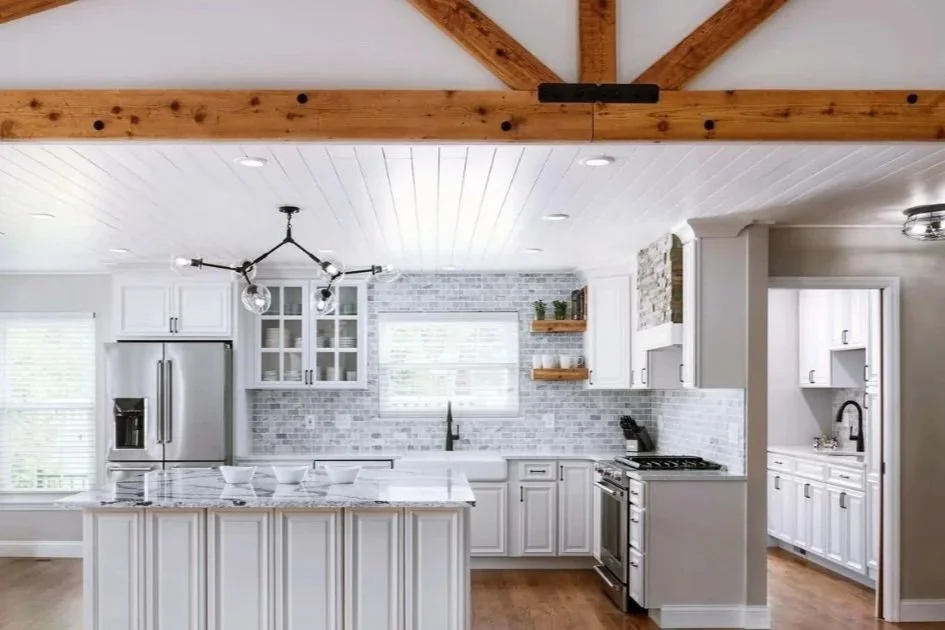
In a well-built room, the ceiling isn’t an afterthought—it’s a surface that controls light, calm, and proportion. Homeowners around Greater St. Louis often tell us the same thing after a remodel: “I can’t put my finger on it, but the space just feels finished.” Nine times out of ten, it’s not one big showpiece. It’s a series of correct, quiet decisions—like using the right paint on the right plane.
Ceilings and walls live different lives. Walls get touched, wiped, leaned on, bumped by furniture, and grazed by sunlight at an angle that reveals every imperfection. Ceilings mostly reflect light and hide above your line of sight—until the wrong sheen turns them into a spotlight for roller marks and patches.
This guide breaks down the real differences between ceiling paint and wall paint, when each belongs, and how a craftsman’s approach prevents the common problems that make a new paint job look “good for now” instead of “right for years.”
Ceiling Paint vs. Wall Paint: What’s the Difference and When Should You Use Each?
Ceiling paint and wall paint are formulated for different jobs. The difference isn’t marketing—it shows up in sheen, thickness, coverage behavior, and long-term appearance.
Use ceiling paint when:
You want a non-reflective surface that hides minor flaws (seams, repairs, subtle texture shifts).
You’re working with critical lighting—tall windows, skylights, or strong afternoon sun—common in many St. Louis living rooms and two-story entries.
The ceiling has patchwork (old light locations, vent moves, repaired cracks) and you need better hide with fewer visible transitions.
You’re painting overhead and want a product designed to spatter less and level out as it dries.
Use wall paint when:
The surface needs washability and scuff resistance (hallways, kitchens, bathrooms, kids’ rooms).
You need durability where hands and furniture will inevitably meet the finish.
You’re building a consistent interior finish system—often matte or eggshell on walls, satin/semigloss on trim—so touch-ups stay predictable.
Most ceilings look best in flat (or “ceiling flat”) because it reflects the least light. Less reflection means fewer distractions—no “banding” between roller passes, no spotlighting of taped joints, no emphasis on a slightly uneven skim coat.
Walls usually perform best in matte, eggshell, or satin, depending on the room. They’re touched constantly, and St. Louis homes see real life—kids racing down a hallway in Kirkwood, dogs shaking off rain by the back door in Crestwood, guests brushing past the stairwell walls during the holidays. A ceiling-grade flat finish on a wall may look beautiful for a week, then quickly show fingerprints and scuffs that don’t clean well.
How we decide in St. Louis remodels: lighting, ceiling height, texture, and use
Here’s the decision framework we use on projects—because the “right” answer changes based on the house:
Light angle and intensity
If a room has strong side light (large windows, sliders, skylights), we lean harder toward flat ceilings to keep the plane visually quiet.
In lower-light rooms, we can sometimes use matte ceiling paint for a slightly richer look—still low-sheen, but a touch more depth.
Ceiling condition
Old plaster with hairline cracking, historic repairs, or uneven skim coats (common in older parts of St. Louis County and city neighborhoods) benefits from dead-flat finishes that won’t highlight waves.
Newly drywalled ceilings with perfect finishing can tolerate a bit more flexibility, but flat is still the safest “always looks right” choice.
Ceiling height
High ceilings—like a two-story foyer—need a finish that won’t turn into a reflective panel. Flat keeps the attention where it belongs: trim lines, stair details, and the architecture.
Basement ceilings are different. If height is tight, we aim for brightness without glare, and that often means flat white with thoughtful lighting design rather than “shinier paint.”
Room use and maintenance expectations
Kitchens and baths are humid, and walls need a finish that cleans well. Ceilings can stay flat in many cases, but we’ll sometimes specify a bath-rated flat/matte designed to handle moisture.
In high-traffic spaces, we prioritize wall finishes that touch up cleanly and don’t burnish when wiped.
If you want a simple homeowner rule that works:
Flat for ceilings. Matte/eggshell for walls. Upgrade durability where life happens.
Then refine based on light, texture, and how perfect you want the surface to read.
The Chemistry and Finish Differences That Actually Change the Result
The reason ceiling paint behaves differently isn’t mysterious—it’s engineered to solve common overhead problems: glare, roller marks, and uneven hide.
Sheen levels: flat, matte, eggshell, satin
Flat (Ceiling Flat):
Best at hiding imperfections. Minimal reflection. The tradeoff is lower washability.Matte:
Slightly more durable and wipeable than flat, still low sheen. A premium matte wall paint can be an excellent “middle ground” in many remodels.Eggshell:
Noticeably more reflective. Great for many walls. On ceilings, it can reveal every patch and roller pass—especially with strong window light.Satin/Semigloss:
Durable and cleanable. Usually reserved for trim, doors, and special cases. Rarely appropriate for standard ceilings unless there’s a specific design reason.
What homeowners often don’t expect: sheen doesn’t just change “shine.” It changes how you perceive flatness of the surface. A ceiling that is technically smooth can look uneven if the finish reflects light in patches.
Viscosity and spatter control
Ceiling paints are commonly formulated to be a bit thicker to reduce drips and spatter when rolling overhead. That makes the application cleaner and helps the film build evenly.
For walls, controlled flow and leveling matter more—especially when cutting in around trim or cabinetry. A wall paint’s formulation supports smoother brushing and rolling on vertical surfaces where the eye is closer and imperfections are easier to spot.
why ceilings often need different pigments
Ceilings are commonly painted in whites and off-whites, and the goal is consistent “read” across a big, uninterrupted plane. Ceiling paint often emphasizes hide so old color, repaired spots, or uneven porosity don’t telegraph through.
That said: hide isn’t a substitute for prep. If a ceiling has water staining, smoke residue, or greasy buildup (kitchen ceilings can surprise people), you need the right primer first or the stain will return.
Washability and scuff resistance
Walls are touched constantly; ceilings usually aren’t. That’s why wall paints often include performance features aimed at durability: better resin systems, improved scrub resistance, and better touch-up behavior.
If you put ceiling paint on a wall in a high-use area, you may get:
Burnishing (shiny spots after wiping)
Scuff retention (marks that don’t clean out)
Patchy touch-ups (the repaired area “flashes” at a different angle)
This is where quality materials matter. A premium wall paint in a matte finish can look close to flat but clean far better—ideal for busy households.
Picking the Right Sheen Room-by-Room
Paint decisions are easiest when you tie them to how a room is used. Here’s how we commonly specify sheens for remodeling projects in Greater St. Louis, with practical reasons behind each.
Living rooms and open-concept main floors
Walls: Matte or eggshell
Ceilings: Flat
Why: Open layouts bounce light across multiple planes. Flat ceilings prevent glare and keep the room feeling taller and calmer. Walls in matte look refined—more “designed” than eggshell—while still handling day-to-day life.
In neighborhoods like Kirkwood or Webster Groves, where older homes often meet modern additions, these choices help the transition feel seamless—old character, new clarity.
Kitchens and baths: steam, grease, and the case for washable finishes
Kitchen walls: Eggshell or satin (depending on traffic and splash zones)
Bathroom walls: Satin or a high-performance matte made for moisture
Ceilings: Flat formulated for kitchens/baths, or matte in persistent humidity
Why: These rooms demand cleanability. In a kitchen, backsplashes protect some areas, but walls still collect fingerprints and cooking residue. Bathrooms introduce humidity; the wrong paint can lead to staining, peeling, or mildew.
This is common in Chesterfield and Town & Country remodels where beautiful new tile and cabinetry deserve a paint system that holds up to real use—not a finish that looks tired after one winter.
Hallways, stairwells, and kids’ zones
Walls: Eggshell (or durable matte in premium product lines)
Ceilings: Flat
Why: These are impact corridors. If you have kids, guests, or pets, you want a wall finish that cleans without leaving shiny wipe marks.
Stairwells in particular—often seen in Central West End homes with taller vertical spaces—benefit from thoughtful sheen control. The wrong sheen can make a stair tower feel stark and reflective, rather than architectural.
Bedrooms and home offices
Walls: Matte
Ceilings: Flat
Why: These are comfort rooms. Matte walls reduce glare from lamps and screens, and flat ceilings keep the room quiet. When the sheen is right, even neutral colors feel richer.
When You Should Use Ceiling Paint on Walls
There are a few narrow moments when using ceiling paint on a wall isn’t a mistake—but they’re exceptions, not the rule.
Great use cases: low-traffic spaces, accent ceilings, tricky light
Closets, storage rooms, utility spaces where washability isn’t important
A low-touch accent wall where you want ultra-low sheen to hide texture
Tricky lighting where any sheen would show surface issues and you’re prioritizing appearance over scrub resistance
Where it fails: wipe marks, fingerprints, and high-use walls
Avoid ceiling paint on walls in:
Hallways
Kids’ bedrooms and playrooms
Mudrooms and entries
Kitchens and baths (especially near sinks or tubs)
Those spaces demand cleanability. A ceiling flat finish will often look “worn” faster because you can’t clean it aggressively without altering the sheen.
The compromise option: matte wall paint in premium formulas
If you love the soft look of flat but need performance, the best answer is usually a premium matte wall paint. It gives you that tailored, low-glare finish while holding up to wiping and touch-ups far better than ceiling paint.
Common Ceiling Conditions in St. Louis Homes—and How Paint Choice Changes the Outcome
Plaster ceilings in older Clayton and University City homes
Plaster ceilings can be beautiful—and unforgiving. Hairline cracks, old repairs, and subtle waves show up when sheen increases. Flat ceiling paint helps minimize those flaws visually, but proper prep matters more: stabilizing cracks, skim coating where needed, and priming correctly.
Textured ceilings and patchwork repairs
Texture hides some issues, but patchwork repairs can “flash” if the porosity isn’t consistent. A dedicated primer plus a true ceiling flat finish keeps the field uniform.
High ceilings in Central West End and Town & Country entries
High ceilings catch angled light in dramatic ways. When homeowners complain that a ceiling looks “streaky,” it’s often sheen plus application technique. Flat paint and a disciplined rolling pattern make the plane read as one clean surface from below.
Low ceilings in finished basements: brightness without glare
Basements in Ballwin, Manchester, and across West County often need a lift—brighter, cleaner, more inviting. Flat white ceilings paired with good lighting design usually outperform “shinier paint,” which can create glare and emphasize low height.
Color Strategy: Why “Ceiling White” Isn’t Always the Best White
Same color as walls vs. lighter ceiling: what each does to the room
Lighter ceiling than walls: makes the room feel taller and brighter; classic approach.
Same color on ceiling and walls: creates a wrapped, modern feel and can hide ceiling angles in rooms with slopes or odd transitions.
Slightly warmed ceiling white: pairs better with warm trim stains, brick, or older materials common in St. Louis homes.
Undertones and north-facing light (a St. Louis reality)
North-facing rooms can skew cool. A ceiling that’s too bright or too blue can feel sterile. We often choose whites based on the home’s fixed elements—flooring, stone, cabinetry—and the direction of light.
Trim, crown, and transitions: keeping lines crisp
If your remodel includes crown molding or detailed casing, the ceiling-wall relationship matters. A clean cut line and correct sheen separation (flat above, matte/eggshell on the wall) makes the trim detail read sharper—like it was meant to be there.
Craftsmanship Matters: The Process That Prevents Flashing, Lap Marks, and Ragged Cut Lines
Prep that lasts: repairs, sanding, stain-blocking primers
Great paint cannot hide poor substrate work. Our approach is finish-first:
Repair cracks and fastener pops properly
Feather sanding so patches disappear
Spot-prime repairs so porosity is consistent
Use stain-blocking primer on water marks or smoke residue
Clean edges: caulk choices and tape discipline
Sharp lines are not luck. They come from:
The right caulk in the right joint (and not over-caulking)
Proper cure times
Skilled cut-in work and controlled brushing
Rolling technique and tools: nap size, pole control, back-rolling
Ceilings often need:
The correct roller nap for texture level
Maintaining a wet edge
Rolling in consistent sections
Back-rolling to even out film build
This is how you avoid “picture framing” and roller banding that shows up when the sun hits at 4 p.m.
Dry times and recoat windows: avoiding sheen banding
Rushing coats causes problems that don’t always show until the paint fully dries. Respecting dry times prevents flashing and uneven sheen—especially important on large ceiling planes.
Practical FAQs Homeowners Ask Before a Remodel or Whole-Home Paint Refresh
-
You can, but it’s rarely the best choice. If the wall paint is anything above matte, it will likely highlight ceiling flaws. Even matte wall paint may behave differently overhead. If you want consistency, choose a ceiling-specific flat (or a premium matte designed for ceilings) and match colors carefully.
-
You can, but it’s rarely the best choice. If the wall paint is anything above matte, it will likely highlight ceiling flaws. Even matte wall paint may behave differently overhead. If you want consistency, choose a ceiling-specific flat (or a premium matte designed for ceilings) and match colors carefully.
-
Flat is the safest and most common because it hides imperfections best. Matte can work when you want a slightly richer look and the ceiling is well-prepped, but it must be chosen intentionally.
-
Not always, but you need primer when:
You’re painting over stains
You have fresh drywall or heavy patches
You’re changing from oil to latex
The existing ceiling is chalky or inconsistent
-
Use a stain-blocking primer first. Painting over stains with finish paint alone often leads to bleed-through. The right primer is the difference between “fixed” and “it came back.”
Ceiling paint vs. wall paint isn’t a small detail—it’s one of those quiet decisions that makes a home feel professionally finished. Flat ceilings calm the light and hide what should stay hidden. Wall paints, chosen with the right sheen and performance, carry daily life without looking tired.
If you’re planning a remodel in Greater St. Louis, use this decision framework:
Ceilings: flat (or thoughtfully chosen matte) for a clean, quiet plane
Walls: matte/eggshell for most rooms; upgrade durability where cleaning is frequent
Kitchens/baths: moisture and washability drive the specification
Prep and technique: the finish only looks as good as the surface beneath it
The goal is simple: a room that looks intentional in every direction you glance—walls, ceiling, trim, and the transitions between them.