
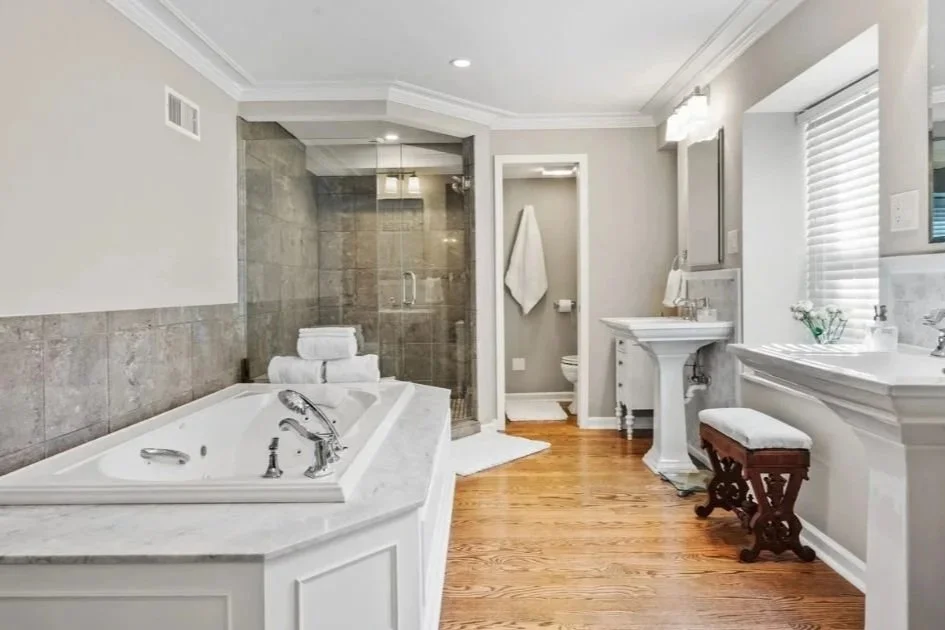
Bathrooms in Missouri work hard. Between humid summers, freeze–thaw winters and the quirks of older St. Louis homes, these small spaces take a beating. Tile begins to crack, grout discolors, paint peels, and no matter how often you clean, there always seems to be a musty smell after a shower.
At Morganco Design Build, we spend a lot of time inside bathrooms in places like Kirkwood, Webster Groves, Clayton, Chesterfield and St. Charles. As a third-generation builder, we’ve opened up enough walls and subfloors to see the same patterns again and again—hidden leaks, undersized fans, outdated plumbing and finishes that were never designed to handle Missouri’s climate.
This guide walks through the most common bathroom issues we see in Missouri homes and, more importantly, how a thoughtful, well-executed remodel solves them for good. The goal isn’t just a prettier bathroom. It’s a bathroom that’s quieter, drier, safer and easier to live with every day.
CHECK OUT: Morganco’s Bathroom Remodeling Service
READ: How Much Does a Bathroom Remodel Cost in Missouri?
Why Missouri Bathrooms Fail Faster (Climate, Age of Homes & Regional Realities)
Humid summers, cold winters & what they do to your bathroom
Missouri lives in temperature extremes. In July, the air can feel heavy and damp; in January, the cold settles into every surface. That constant expansion and contraction is tough on any room, but bathrooms are especially vulnerable because they already deal with daily swings in temperature and moisture.
Hot showers in an already humid environment create steam that lingers. When that moisture doesn’t have a clear path out of the room, it finds its way into paint, grout lines, drywall and even framing. Over time you’ll notice:
Peeling or bubbling paint near the ceiling
Darkened caulk or grout joints around the tub or shower
Condensation on windows and mirrors long after the shower ends
A musty odor even in an otherwise clean bathroom
In winter, the opposite happens: cold exterior walls meet warm interior air. If the wall assembly isn’t insulated and sealed correctly, condensation can form inside the wall cavity. You won’t see it at first, but the damage slowly builds behind the tile and trim.
When we design a St. Louis bathroom remodel, we start by considering these environmental forces. That means correctly sized and ducted ventilation, insulation upgrades where needed, and properly detailed vapor barriers so the room can breathe in a controlled way.
Older St. Louis housing stock and original baths
Many homes in the Greater St. Louis area were built between the 1920s and 1960s—solid brick exteriors, plaster walls, charming details, and very small original bathrooms. In neighborhoods like Webster Groves, Maplewood or South City, we frequently encounter:
Single small hall baths serving an entire family
Plumbing stacks that haven’t been touched in decade
Tile set directly on a thin mud bed or failing subfloor
Vent fans that exhaust into an attic instead of outdoors—or no fan at all
These spaces often held up surprisingly well for a long time, but once problems start, they accelerate. Hairline cracks in grout become pathways for water. Old cast-iron or galvanized pipes corrode from the inside out. Floors develop a bounce as the subfloor weakens around the tub.
Our job is to respect the character of these older homes while bringing the performance of the bathroom up to modern standards. That might mean reframing a floor in a 1930s brick bungalow, relocating plumbing in a Ladue two-story, or carefully integrating new mechanical systems into plaster and lathe walls without butchering historic details.
Building codes and expectations have changed
Bathrooms that passed inspection 30 or 40 years ago wouldn’t meet today’s codes or expectations for comfort. Missouri homeowners now assume:
Properly sized GFCI-protected outlets
Dedicated circuits for hairdryers, heated floors or jetted tubs
Ventilation that actually clears moisture
Non-slip surfaces in wet zones
Showers built with modern waterproofing systems rather than just tile over drywall
When we remodel a bathroom, we treat it as an opportunity to bring the entire space up to current code and best practice—not just swap finishes. That means:
Evaluating framing, plumbing and electrical against today’s requirements
Correcting unsafe conditions we find, even if they aren’t visible from the finished room
Documenting what’s been updated so future buyers and inspectors understand the quality of the work
By starting with a clear understanding of Missouri’s climate, the age and style of your home, and current building standards, we can address the real causes of bathroom problems—not just cover them with new tile.
READ: What Permits Do You Need For a Bathroom Remodel?
Moisture, Mold & Mildew: The Most Common Missouri Bathroom Problem
Signs your bathroom has a moisture problem
Most Missouri bathrooms we’re called to remodel show at least one of these warning signs:
Persistent fogged mirrors and windows even 20–30 minutes after a shower
Staining or yellowing on the ceiling, especially above the shower or along outside walls
Black or reddish spots forming on caulk lines or grout joints
Soft or spongy drywall around the tub surround or where the tile meets painted walls
A musty smell that returns shortly after cleaning
In a Clayton primary suite we renovated, the owners thought they simply had “old grout.” Once we opened the wall, we found mold growth behind the tile, saturated insulation, and a fan that vented only into the attic. The finishes were the symptom; moisture management was the real issue.
During our initial visit, we look for these clues and ask questions about how the room feels through the seasons. That information shapes the mechanical and material decisions that follow.
READ: Common Basement Moisture Issues in Missouri
Why fan size, ducting and air flow matter more than you think
A vent fan is not just a box in the ceiling. For Missouri bathrooms, three details matter:
Capacity (CFM rating) – The fan must be sized to the room’s volume and use. A large walk-in shower and soaking tub in a Chesterfield home demands far more airflow than a small hall bath in a South City bungalow. We calculate the correct CFM rather than guessing.
Ducting and termination – Even the best fan fails if it’s pushing moist air into an unconditioned attic or through a long, kinked flex duct. We design straight, insulated duct runs that terminate at a proper roof or wall cap to avoid condensation and ice issues.
Switching and control – Timers and humidity-sensing switches keep the fan running long enough to clear moisture without constantly relying on someone to remember to flip a switch.
When we remodel, we often replace undersized, noisy fans with quiet, high-efficiency units that homeowners actually use. The difference in day-to-day comfort is noticeable: mirrors clear faster, odors dissipate quickly, and the room simply feels fresher.
Material choices that stand up to Missouri humidity
Moisture control isn’t only mechanical; it’s also material. In a humid climate, some products age gracefully and others fail quickly. We pay close attention to:
Backer boards: We use cement board or high-performance foam backers in wet areas, never standard drywall behind showers or tubs.
Waterproofing membranes: Modern sheet or liquid-applied systems create a continuous waterproof layer behind tile. This is a critical upgrade from old-school methods still used by some contractors.
Grout and caulk: High-quality, stain-resistant grouts and flexible sealants at change-of-plane joints help prevent cracking and water intrusion.
Cabinet construction: In bathrooms without great natural ventilation, we favor plywood cabinet boxes and durable finishes over particleboard that swells with repeated exposure to humidity.
In a recent Wildwood project, the homeowners loved the idea of a natural marble shower. We walked them through the maintenance requirements and instead designed a large-format porcelain tile that mimics marble but performs far better in a busy family bath. It delivers the same visual impact with far less risk of staining and etching from hard Missouri water.
Leaks, Rot & Failing Subfloors: When Water Gets Behind the Finish
How small leaks turn into major structural repairs
Water rarely announces itself dramatically. Most bathroom damage we uncover began as a tiny problem:
A cracked grout line at the outside corner of a shower
A loose toilet that rocks slightly when used
A tub spout with a slow drip that runs down the wall
Left alone, these small issues allow water to migrate into the subfloor, framing and wall cavities. Over months and years, wood fibers break down, fasteners rust, and the structure softens. By the time the homeowner feels a “soft spot” in the floor, the damage is usually much more extensive.
In a 1970s ranch in Ballwin, a wobbly toilet turned out to be the tip of the iceberg. Once we removed the existing tile, we found the subfloor completely rotted around the flange and moisture wicking several feet in each direction. The solution was not just a new toilet; it involved reframing sections of floor joists, installing new subflooring and rebuilding the finish assembly from scratch.
Proper waterproofing for showers, tubs and wet walls
A well-built shower is a system, not just tile and grout. For St. Louis bathroom remodeling, we rely on proven waterproofing methods:
Pre-sloped shower pans that direct water toward the drain, not toward corners or walls
Continuous waterproof membranes that wrap the floor, curb and walls to a specified height—no gaps at niches or benches
Careful detailing at transitions, such as where the shower meets the bathroom floor, around windows in showers, and at tub deck interfaces
We also pay attention to how water actually behaves in the space. For example, in a Ladue primary suite with a large walk-in shower, we repositioned the showerhead and added a secondary handheld to keep water spray away from the entry and bench. Design decisions like this protect finishes while improving usability.
Rebuilding the “bones” of the bathroom the right way
When moisture has compromised the structure, simply installing new tile is a short-term fix. Our approach is more deliberate:
Selective demolition – We remove finishes carefully to evaluate the condition of joists, studs and subfloors.
Structural repair – Damaged framing is sistered, replaced or re-engineered to meet current standards. This step is especially important in older brick homes where floor systems weren’t originally designed for modern tile assemblies and large tubs.
Subfloor and underlayment – We install subfloor materials rated for tile and wet areas, fastened correctly and, where appropriate, coupled with uncoupling membranes to allow for slight movement.
Moisture-resistant assemblies – From there, we layer in waterproofing, insulation and air sealing before any visible finishes go back in.
Homeowners rarely see this part of the work, but it’s where longevity is won or lost. As a third-generation builder, we take pride in knowing that the unseen structure is as carefully built as the visible finishes.
Outdated Plumbing & Low Water Pressure in St. Louis–Area Homes
Galvanized pipes, mixed materials and hidden risks
Many Missouri homes still have sections of galvanized steel piping or a mix of different materials that have been pieced together over the decades. Common problems we encounter include:
Reduced water pressure from corrosion buildup inside old pipes
Discolored water when fixtures are first turned on
Leaks at transition points where different metals meet without proper dielectric fittings
In a 1940s brick home in University City, we traced chronically low shower pressure back to a short section of original galvanized pipe buried in the wall. During the remodel, we opened the wall, replaced the outdated lines with modern PEX and copper, and reconfigured the layout to supply the shower with adequate volume and balanced temperatures.
Upgrading supply lines, drains and venting during a remodel
A full bathroom remodel is the ideal time to correct plumbing issues that would otherwise remain hidden:
Supply lines – We replace aging, undersized lines with appropriately sized, code-compliant piping to support modern fixtures like multi-head showers or large soaking tubs.
Drain lines – Old cast-iron or undersized drains are upgraded to PVC or ABS with proper slope and cleanouts for long-term reliability.
Venting – Correct venting is essential to prevent gurgling drains, sewer gas odor and slow fixtures. We evaluate the entire system, not just the visible traps.
By addressing the plumbing infrastructure while walls and floors are open, we help homeowners avoid future leaks and provide a more consistent, comfortable experience every time the shower turns on.
Planning for future fixtures, additions and resale value
Thoughtful plumbing design considers the future:
Running lines sized to accommodate a potential second sink in a kids’ bath
Roughing in for a future bidet or upgraded toilet in a primary suite
Planning drain locations so a tub could be swapped for a larger shower down the road
In growing families across Chesterfield and O’Fallon, we’ve seen how these small, forward-thinking decisions pay off. When it’s time for the next phase of renovations, the groundwork is already in place instead of requiring major rework.
Cracked Tile, Sloping Floors & Movement in Missouri Homes
Foundation movement, framing and what’s underneath your tile
Missouri’s clay soils and freeze–thaw cycles can cause foundations and framing to move over time. When that movement telegraphs into a rigid material like tile, the result is:
Hairline cracks that spread across the field of tile
Grout joints that crumble or powder
Corners that open up where two tiled walls meet
Sometimes the problem is structural movement; other times it’s simply that the original tile was installed over inadequate subflooring. We diagnose the real cause before proposing a solution.
In a Kirkwood home, the owners complained about “constantly cracking grout” in an upstairs bathroom. Our inspection showed a combination of undersized joists and a subfloor that flexed under normal use. Before reinstalling tile, we reinforced the framing and added proper underlayment to create a stable base.
Subfloor prep that prevents cracked grout and tile
Quality tile work starts long before the first tile is set. Our process typically includes:
Checking joist span and deflection to ensure the structure can support tile without excessive movement
Installing appropriate subfloor thickness, often with an added layer of underlayment to stiffen the assembly
Using uncoupling membranes where beneficial to absorb minor movements and reduce stress on the tile
Ensuring flatness – Large-format tiles, which are popular in modern St. Louis bathroom remodels, require very flat substrates to prevent lippage and cracking
This level of preparation takes time, but it’s what keeps a beautiful bathroom looking crisp and solid for decades rather than just a few years.
When radiant heat or leveling compounds make sense
In some Missouri bathrooms—especially in older homes with uneven floors—we may recommend:
Self-leveling underlayments to correct significant dips or waves before installing tile
Electric or hydronic radiant floor heat embedded in the floor assembly, which not only adds comfort on cold mornings but also helps floors dry faster, reducing slip risk and mildew growth
We used this approach in a historic Central West End home where the bathroom floor sloped noticeably toward one corner. By carefully leveling the subfloor and integrating radiant heat, we delivered a flat, warm surface that feels substantially more luxurious and safe.
Layouts That Don’t Fit the Way You Live Today
Tiny showers, awkward toilets and wasted space
Many original Missouri bathrooms were designed for a different era—one small tub, a single sink and little regard for storage or privacy. Today’s families need more:
Larger, more comfortable showers
Separate zones for partners getting ready at the same time
Privacy for the toilet area
We often see floor plans where the door swings into the vanity, the toilet is the first thing you see from the hallway, or a cramped alcove tub makes the entire room feel smaller than it is. In a Brentwood home, simply swapping the locations of the shower and toilet allowed us to create a generous walk-in shower and a more discreet, comfortable toilet nook without expanding the overall footprint.
READ: Smart Bathroom Layouts That Make the Most of Limited Space
Reworking walls, doors and windows for better flow
Thoughtful layout changes don’t always require an addition. Techniques we commonly use include:
Pocket doors or outswing doors to free up useable floor space
Borrowing space from adjacent closets or oversized bedrooms to enlarge a primary bath
Shifting or resizing windows to allow for a full-height shower wall while still bringing in natural light
Our design team studies the structure, plumbing runs and adjacent rooms carefully. The goal is to align function with the way you actually move through the space—early morning routines, kids’ bath time, guests staying for the weekend—while respecting the architecture of your St. Louis home.
Designing for real life: families, guests and busy mornings
We design bathrooms around how they will be used day in and day out:
Two sinks and ample counter space for busy households
Durable surfaces that stand up to kids, pets and real life
Thoughtful placement of towel bars, niches and hooks so everything has a place
In a multi-generation household in St. Charles, we designed a hall bath that works both as a kids’ bath and as a guest bath—separate storage zones, a deep tub for the little ones and finishes that look sophisticated when guests visit.
Storage, Lighting & Electrical
Smart storage for older Missouri homes with small closets
Storage is often the difference between a bathroom that always feels cluttered and one that feels calm. In many St. Louis homes, existing linen closets are small or poorly located. We look for inventive ways to add:
Tall linen cabinets integrated with the vanity
Recessed niches between studs for everyday items
Built-in benches with hidden storage in larger showers or by windows
A Clayton homeowner once told us her biggest frustration wasn’t the tile or the tub—it was having nowhere to keep extra towels. Our solution was a custom, shallow linen cabinet that fits between wall studs and looks original to the home.
Layered lighting for makeup, shaving and relaxing
Bathrooms do many jobs. One light in the middle of the ceiling can’t do them all. Our lighting plans usually include:
Task lighting at the mirror, positioned to minimize shadows on the face
Ambient ceiling lighting to fill the room evenly
Accent lighting—such as toe-kick LEDs or cove lighting—for nighttime use and spa-like ambiance
We also specify color-accurate, dimmable LEDs so the room can shift from bright and functional in the morning to soft and calming in the evening.
Safe, code-compliant electrical in wet spaces
Older Missouri bathrooms often have:
Too few outlets
No GFCI protection
Shared circuits that trip whenever a hairdryer and space heater run together
During a remodel, we plan electrical with both safety and convenience in mind:
Dedicated circuits for the bathroom
Properly located GFCI-protected outlets
Pre-wiring for heated floors, mirrors with integrated lighting, or future upgrades
We coordinate closely with our licensed electricians to ensure everything meets or exceeds current code while keeping switches and devices cleanly integrated into the design.
Comfort, Safety & Accessibility for Every Stage of Life
Warmer floors, better acoustics and everyday comfort
A well-designed bathroom should feel good to use. In Missouri’s colder months, stepping onto a warm tile floor changes the whole experience of a winter morning. Insulation upgrades, quieter fans and solid doors also improve acoustics and privacy, especially in homes where bathrooms sit right off main living areas.
Slip resistance, grab bars and zero-threshold showers
Safety is a concern at every age, not just later in life. We often recommend:
Slip-resistant floor tiles with appropriate texture, especially in wet zones
Blocking in the walls for future grab bars, even if they’re not installed right away
Zero-threshold or low-curb showers that are easier to enter and exit
When done thoughtfully, these features blend seamlessly into the design. In a recent Kirkwood primary bath, grab bars were integrated into a sleek, matte-black fixture package and look like intentional design elements rather than medical equipment.
Planning now for aging in place in your St. Louis home
Many of our clients tell us they plan to stay in their homes long-term. When we remodel a bathroom with that future in mind, we consider:
Wider clearances for walkers or wheelchairs
Vanity heights and hardware that are comfortable for all users
Space to add a shower seat later without major changes
These considerations don’t add significant cost during a full remodel, but they can save substantial expense and disruption later.